Community Action Plans are a nationally recognised way of evidencing the challenges, opportunities and needs of unique communities, and using that evidence to guide community development work.
Between September 2024 and November 2025 we facilitated the development of a Community Action Plan for Dunvegan and District Community Council area. The resulting plan belongs to everyone here, and we can all use and refer to it, and act on its findings. You can read and download the plan here, and read more about the process below.
The benefits of creating a Community Action Plan were raised at Dunvegan Community Trust’s 2024 AGM. With the co-operation of Dunvegan Community Council and initial funding from the Community Regeneration Fund, and plus further funding from Nadara, Dunvegan Community Trust began working on the Community Action Plan in September 2024.
Often, communities need to outsource much of the work of the development and production of a Community Action Plan to external consultants and designers. This takes a lot of the pressure off of the anchor organisation, but we wanted to take advantage of the skills we have in our community and keep the work and process as local as possible.
We engaged a DCC resident researcher to:
• Support the development of the structure of the plan
• Advise on a method of engagement
• Undertake desktop research gathering all of the publicly available information on our locality into one place
• Develop and analyse a community survey
• Write the final Plan
The first part of this research was context-setting, which included reviewing community consultation work already conducted locally, to identify themes and projects already highlighted by local voices.
We held an inception meeting in Dunvegan Hall to discuss the context of the Community Action Plan, with the help of Community Enterprise, and Catherine MacPhee from Skye and Lochalsh Archive Centre. We discussed and gathered feedback on topics to be explored, and over the course of the next 6 months we held nine Public Events discussing: Housing; Land and Sea; Families and Young People; Sport and Leisure; Music and Culture; Health and Resilience; Transport, Paths and Getting Around; Environment and Climate. The events were well attended, with just under 250 turning out in total across the 9 events. We varied the days and times of our events to allow maximum attendance, some on weekday evenings, some on Saturday afternoons, and we also held a number of drop ins at the Community Cafe and Community Hall during the week to allow people to have an informal chat. We also attended the local Senior Citizen’s lunch club and Bun Sgoil Dhun Bheagain, joined by our local Archivist from Skye and Lochalsh Archive Centre, and held a teen engagement event in Dunvegan Hall.
A major part of these events included the opportunity to map what we would like to see, where. We brought A1 size maps of Dunvegan Community Council area, North West Skye, the village of Dunvegan itself, and the other townships in our geographic community. We also created transparencies of key mapping considerations, illustrating:
• Land and foreshore ownership in the North West (see Map transparency 1)
• Crofting townships (see Map Transparency 2)
• Catchment areas of Bun Sgoil Dhun Bheagain and Dunvegan Medical Practice (see Map transparency 3)
This spatial approach to discussing project and development has been really important in discussing legacy projects relating to housing, environment, transport and economy. Our Community survey launched in January 2025, also structured across these defined topics, with the addition of questions about our demographics and income. We were determined to make sure the survey was as in depth as possible, to give respondents the opportunity to dig deep into their local knowledge and experience. Having a survey which was designed and delivered in a very local way meant that despite being 70 questions long, it all felt very relevant. We delivered hard copy surveys to every household in the DCC area, as well as the option of online completion. We had a fantastic response - 130 adult responses (40% of our households). As Dunvegan itself is a hub for public services and employment for the wider North West, we also designed an online survey for people outwith the DCC area, gaining 70 responses. We had an online survey specifically for teens, and a bilingual paper survey for primary aged children, which was completed at school, with 36 responses.
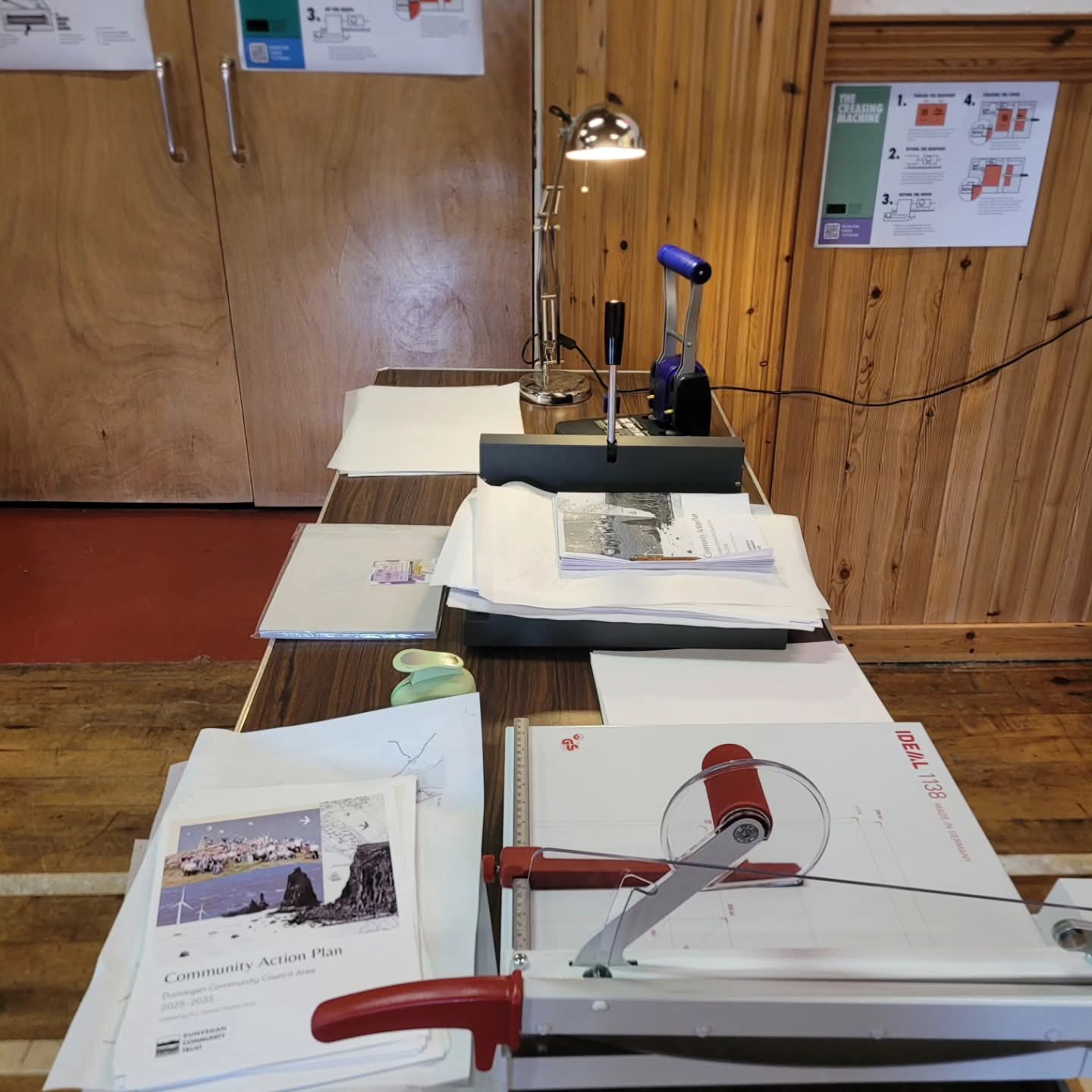
Had we outsourced this work beyond the community, we wouldn't have even been given the option of developing such a comprehensive survey, or including neighboring communities in its scope- or we certainly wouldn't have been able to afford it! The survey report and information was presented to the community at an event in April 2025, with the collation of all of the desktop research, survey data and face-to-face feedback being collated in the second half of 2025. It was designed by a Dunvegan resident graphic designer, and the first print run was made in Dunvegan Hall in November 2025 with the ATLAS Arts community press.